Wind direction is the key to successful deer hunting. Why? Because deer rely heavily on their sense of smell, which is about 10,000 times stronger than ours. If the wind carries your scent to a deer, your chances of success drop significantly. Here’s what you need to know:
- Deer detect scent up to 300 yards away. Wind determines where your scent travels, forming a cone-shaped trail.
- Position stands with wind in mind. Always set up downwind or crosswind of deer travel routes.
- Terrain and thermals matter. Morning thermals carry scent upward; evening thermals pull it downward. Hills, ridges, and valleys can redirect airflow unpredictably.
- Swirling winds are tricky. Broken terrain and gusts scatter scent, making scent control harder.
- Deer use wind to stay safe. Mature bucks often bed with the wind at their back to detect threats.
The solution? Use tools like wind-check powders to monitor airflow, plan strategic stands for different wind conditions, and leverage terrain features like ridges and funnels to control scent direction. Always check wind at stand height and adjust based on shifting conditions. Mastering these strategies ensures deer won’t detect you before you even get a chance.
Wind Speed, Direction & Thermals | Art of Scent Control
sbb-itb-e01ab49
The Problem: Wind Direction and Scent Control Challenges
You’ve scouted the area, picked the perfect tree, and settled in. Then the wind shifts. Suddenly, all your preparation feels wasted as your scent betrays your position. This is the harsh reality hunters face when dealing with unpredictable wind patterns.
How Changing Winds Ruin Your Hunt
Swirling winds are a hunter’s nightmare when it comes to scent control. A steady breeze might carry your scent in a single, predictable direction, but gusts? They scatter it chaotically, making it nearly impossible to manage. One moment the wind is in your favor, and the next, it’s funneling your scent straight to a deer’s nose.
This problem gets worse in broken terrain. Ridges and valleys create unpredictable wind pockets, amplifying the challenge. On still days, the situation doesn’t improve. With no significant wind to carry your scent away, it lingers around you, spreading out in all directions. Even a light breeze of 0–5 mph can hold your scent close to the ground, exactly where deer are moving. Add uneven terrain to the mix, and the wind’s behavior becomes even harder to predict.
Unpredictable scent drift doesn’t just ruin your chances - it forces deer to change their behavior entirely.
How Deer Use Wind to Avoid Danger
Deer don’t just react to the wind - they actively use it to their advantage. Mature bucks, in particular, are strategic about where they bed down. They often choose spots where the wind blows from behind or across their position, giving them an early warning system for approaching threats.
When deer catch even a faint whiff of something suspicious, they don’t stick around to investigate. Instead, they circle downwind to confirm the scent. If it’s a threat, they’ll either bolt or quietly retreat.
Here’s why this works so well for them: A whitetail deer’s nose is incredibly powerful, with approximately 297 million scent receptors - far more than a human’s 5 million. When a deer detects a potential threat, it adopts an alert posture: ears forward, head raised, and nostrils flared. By the time you notice these signs, the deer has likely already decided you’re a danger. It’s either gone or planning its escape.
This heightened awareness and reliance on scent make wind assessment critical when setting up your stand. Without it, you’re giving deer the upper hand before you even get started. To ensure your setup is optimized for success, consider booking a hunt with experts who understand local wind patterns.
How Wind and Terrain Affect Deer Movement
Knowing how wind works is just the start - you also need to understand how terrain shapes it. The landscape doesn’t just block wind; it redirects air currents in ways that can either help or hurt your strategy. Hills, valleys, and ridges create unique airflow patterns that shift throughout the day.
Morning and Evening Thermals
Building on the basics of wind direction, daily thermal shifts play a big role in scent management. Temperature changes drive air movement vertically. In the morning, as the sun heats the ground, the air warms, becomes lighter, and rises. These updrafts carry your scent away from deer travel zones . By evening, the ground cools, and the air sinks, pulling your scent downward into low-lying areas where deer are often active .
This thermal cycle impacts how deer move. In the morning, deer tend to move uphill, using the rising air to detect anything below them. In the evening, they move downhill, relying on sinking air to scent-check the terrain above. As John Gay from HuntWise explains:
"Whitetails live and die by their nose, so it's no wonder that deer are the olfactory champions of the woods".
Midday heat creates a different challenge. The peak warmth of the day causes turbulent, unpredictable air currents, often called "swirling thermals" . These unstable patterns make scent control much harder, as the air movement becomes chaotic. Combined with the landscape, these thermal shifts add another layer of complexity to wind behavior in your Kentucky hunting grounds.
How Terrain Changes Wind Patterns
On top of thermal effects, terrain significantly alters wind flow, which is crucial for setting up your stand. Wind moves like water around obstacles. As StoneRoadMedia describes:
"Think of the wind as flowing water, rocks and boulders in a stream simply replaced by cliffs and hills. Obstacles like hills, bluffs, and trees divert wind by altering its course".
This diversion can create micro-eddies - small pockets of swirling air that might expose your position, even when the main wind direction seems favorable .
Terrain also amplifies thermal effects. For instance, a ridge that catches early sunlight generates stronger updrafts, while shaded valleys stay cooler longer, delaying thermal shifts. Features like saddles and funnels channel airflow into tight corridors, which attract deer but make scent control tricky . Water sources like ponds and creeks cool the surrounding air, pulling scent downward, while rocky bluffs heat up faster and create steady updrafts later in the day. Learning how these terrain-driven wind patterns work can help you place your stand more effectively and manage scent challenges better. For personalized advice on stand placement, you can consult a professional guide to help scout your specific terrain.
Solutions: Setting Up Stands Based on Wind Direction
Understanding how wind interacts with terrain is just the first step. Now it’s time to put that knowledge to work by strategically placing your stands. The key? Keep your scent far from areas where deer are likely to travel, bed, or feed. To do this, plan your primary stand around the dominant wind patterns in your area and have backup options ready for when the wind shifts. Let’s break it down.
Placing Your Primary Stand for Dominant Winds
Your primary stand should be positioned with the dominant wind in mind. Tools like smartphone apps and hunting software can help you track wind forecasts and analyze historical wind data for your hunting area.
Once you identify the dominant wind direction, set up your stand downwind of deer travel routes. For mature bucks, take it a step further by placing your stand "downwind of downwind", which means positioning it even farther from their typical paths. Use topographic maps to locate areas with natural barriers - like steep hillsides or thick brush - that prevent deer from entering your scent cone.
Elevation also plays a big role, especially when factoring in thermals. Steve Flores from DeerLab explains how thermals work:
"In the mornings, as the heat from the sun warms the air, it begins to rise. Therefore, any scent or odor that is floating around in the air will rise uphill. On the other hand, as the sun goes down in the evening, the air begins to cool and fall."
In the morning, position your stand slightly below the travel route so the rising air carries your scent away from the deer. In the evening, stay downwind or at ground level to ensure your scent is pulled away by the cooling air.
Setting Up Backup Stands for Different Wind Conditions
Relying on just one stand can limit your flexibility. When the wind changes, backup stands allow you to adapt without compromising your hunt. Since wind shifts are inevitable, prepare multiple stands for different wind directions - such as one for an east wind and another for a northwest wind. As Bone Collector puts it:
"If you check the forecast in the morning and see that the wind is different than you planned, you can simply hunt a tree stand where the wind is in your favor."
Mark each backup stand with its ideal wind direction in your tracking app. Make sure each site has a dedicated access route to avoid spreading scent near bedding areas or food sources during entry and exit. On public land, scout several potential locations to cover various wind scenarios. A climbing tree stand can also help you stay mobile. Regularly check wind forecasts - daily and even hourly - to pick the best stand for the conditions.
Testing Wind at Stand Height
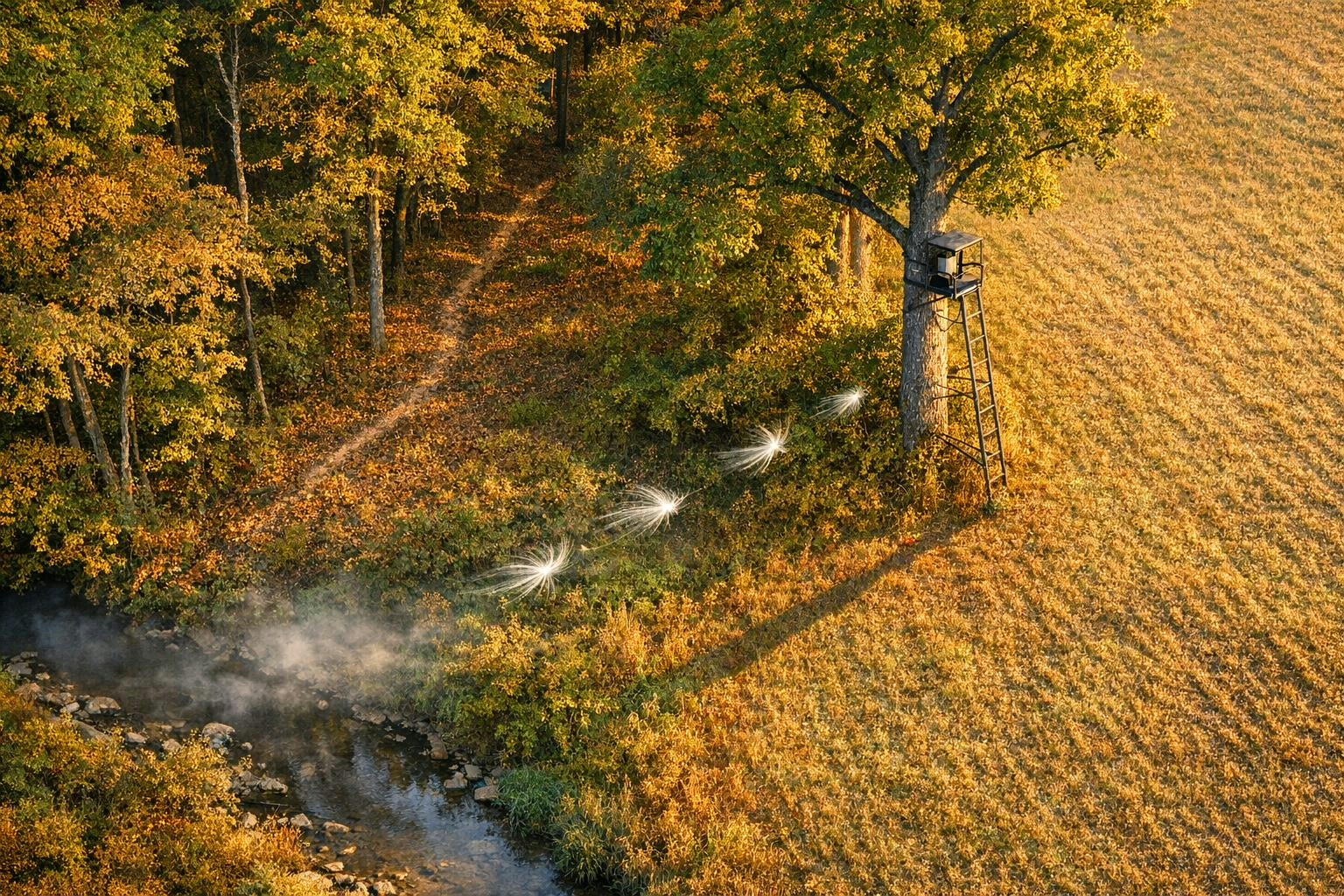
Even with careful planning, it’s vital to verify wind conditions on-site. Forecasts can only tell you so much - wind at 20 feet in the air may behave differently than at ground level, especially near terrain features that cause swirling air. Bring a powder puff bottle to check real-time air currents. These wind checkers can reveal airflow patterns that apps might miss.
Deer are highly sensitive to even subtle wind changes, so double-checking wind direction at stand height is essential. Attach a ribbon or streamer to your stand to monitor shifts throughout your hunt. If the wind shifts more than 30 degrees, it’s time to consider relocating. Additionally, feel the ground for moisture and temperature - damp, cool ground suppresses thermals, while dry, sun-warmed surfaces enhance rising air currents. Wild Camo sums it up well:
"The real foundation of scent control is air movement. Understanding how the wind and thermals carry and mix my scent gives me the ability to place myself where deer aren't likely to smell me."
Regularly test and adjust your setup to stay ahead of changing wind conditions.
Adjusting Your Setup for Different Terrain
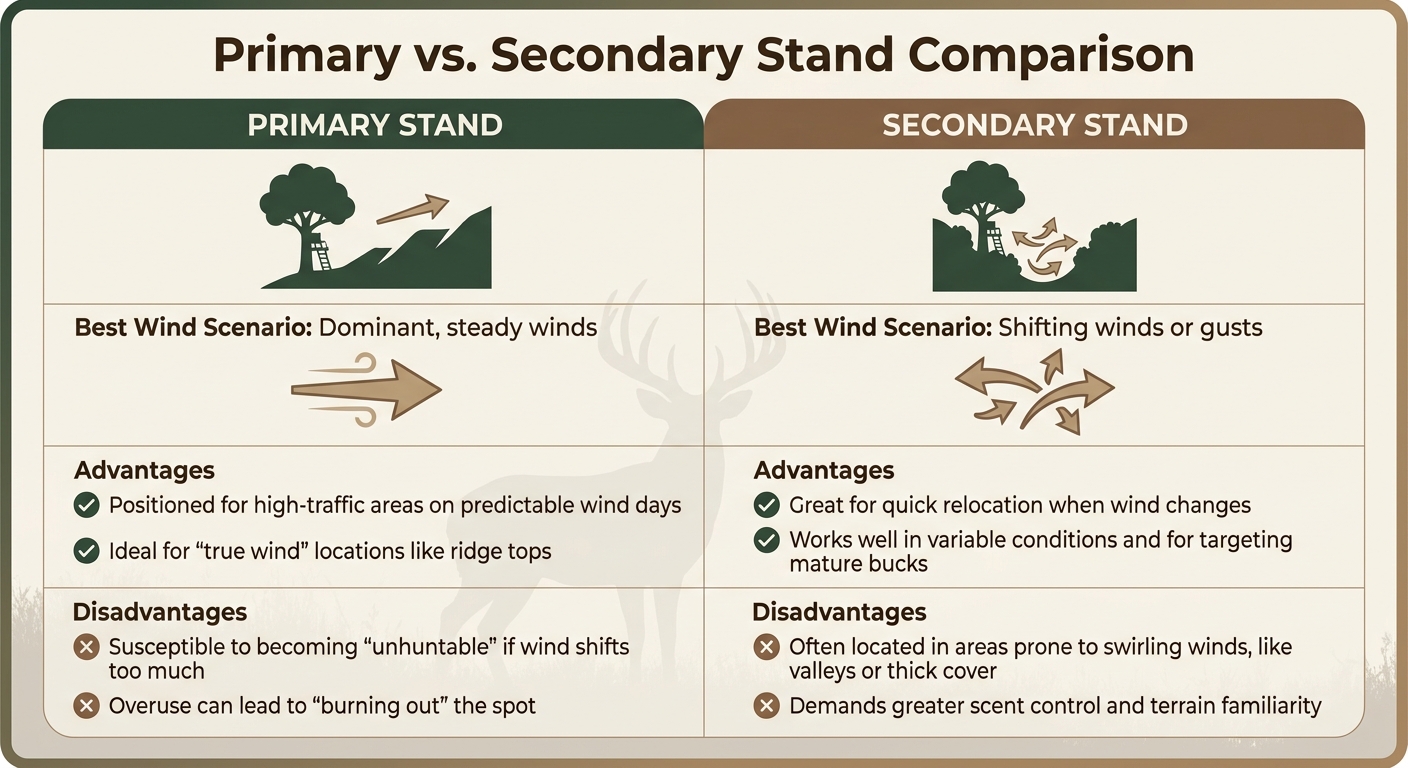
Primary vs Secondary Deer Stand Setup Comparison Chart
When it comes to deer hunting, understanding how terrain and wind interact can make or break your success. Terrain doesn’t just define the landscape - it also dictates how air and scent move. Features like ridges and valleys create natural pathways for airflow, and knowing how these elements work together can help you position your stand so your scent stays controlled and avoids spooking deer.
Stand Placement on Ridges and in Valleys
Ridges and plateaus are excellent locations for primary stands because they offer predictable scent dispersal. Narrow features like saddles and funnels further concentrate airflow, channeling scent through tight spaces with greater intensity. On a ridge, position your stand so that your scent rises and bypasses deer moving below.
Valleys, on the other hand, can be tricky. Cooler air tends to settle in these low areas, trapping scent close to the ground, especially during temperature inversions. In the morning, consider setting up on the downhill side of a ridge or in a hollow, where rising thermals will carry your scent upward and away from deer on higher ground. By evening, as air cools and begins to sink, avoid high ridges where your scent might linger. Instead, set up at lower elevations or downwind of travel routes, as cooling air will cause scent to stay closer to the ground.
On windy days, exposed ridgelines can create unpredictable conditions. In these cases, move to more protected areas like funnels or deep draws, where the terrain helps block gusts and keeps scent movement steadier. Wild Camo puts it perfectly:
"I never rely on wind alone; terrain shapes airflow as much as wind origin".
Since terrain and airflow change over time, you’ll need to adjust your stand locations to match these evolving conditions.
How Seasonal Wind Changes Affect Stand Location
Seasonal wind shifts add another layer of complexity to stand placement. Early in the season, prevailing winds are typically more consistent, making ridge-top stands a reliable choice. However, as fall transitions into winter, wind patterns become less predictable, and secondary stands in sheltered areas become increasingly important.
During the rut, bucks often travel crosswind to maximize their ability to scent-check for does. Setting up perpendicular to well-used trails can allow non-target deer to pass without detecting your scent. For mature bucks that prefer traveling with the wind in their face, try the "almost-wrong" wind strategy. This involves positioning your stand at a slight angle - like setting up with a south-southwest breeze for a buck moving south - so your scent just narrowly avoids detection.
Thermal activity also shifts with the seasons. In the morning, thermals might not start rising until about an hour after sunrise, and in the evening, they may not begin falling until closer to dusk. If you’re hunting from a hillside stand and deer are bedded above you, it’s better to wait nearby on the ground until evening thermals start to drop. This way, you avoid accidentally sending your scent uphill during the transition.
Comparison Table: Primary vs. Secondary Stands
| Stand Type | Best Wind Scenario | Advantages | Disadvantages |
|---|---|---|---|
| Primary Stand | Dominant, steady winds | Positioned for high-traffic areas on predictable wind days. Ideal for "true wind" locations like ridge tops. | Susceptible to becoming "unhuntable" if wind shifts too much. Overuse can lead to "burning out" the spot. |
| Secondary Stand | Shifting winds or gusts | Great for quick relocation when wind changes. Works well in variable conditions and for targeting mature bucks. | Often located in areas prone to swirling winds, like valleys or thick cover. Demands greater scent control and terrain familiarity. |
Conclusion: Key Takeaways for Effective Stand Setup
Review of Wind and Scent Control Methods
When it comes to stand placement, wind direction isn't just important - it’s everything. A deer’s sense of smell is about 10,000 times stronger than ours, enabling it to detect human scent from as far as 300 yards away in the right conditions. Even the best camouflage or stealth won’t save you if the wind carries your scent directly into a deer’s path.
The core principle is straightforward: place your stand so the wind blows from the deer’s expected location toward you, not the other way around. Keep in mind how thermals behave - rising in the morning as the ground heats up and sinking in the evening as it cools. Use natural features like ridges and funnels to guide your scent away from where deer are likely to be. Steady winds between 5–15 mph are ideal for creating a consistent scent path, unlike light breezes or unpredictable gusts. As Dave Hurteau, Executive Editor at Field & Stream, aptly explains:
"No matter how good a deer's nose is, it can't smell you unless the wind carries your stinky scent particles to its nose".
Your approach and exit routes are equally critical. If your scent contaminates bedding or feeding areas during your entry, you may lose the chance for a successful hunt before it even starts.
Stay Flexible and Keep Testing Your Setups
Flexibility is the key to success when wind conditions change. Experienced hunters prepare by maintaining multiple stand locations suited to different wind directions, and they aren’t afraid to relocate if conditions shift. Studies show that deer tend to move more during windy days but less during windy nights, so adjust your strategy not just to the wind but also to the time of day.
Always confirm wind direction at your stand using tools like milkweed silk or a puff bottle, as local terrain can create small wind currents that differ from general forecasts. Instead of aiming to eliminate all scent, focus on managing it - keeping your odor away from areas where it could alert deer. By testing your setups and staying adaptable, you’ll improve your odds of outsmarting a deer’s sharp nose, giving you more chances to succeed.
FAQs
What wind speed is best for hunting a stand?
When it comes to hunting from a stand, calm to moderate wind speeds are generally ideal. These conditions help keep deer movement more predictable and reduce the chance of excessive noise that might spook them. That said, hunting can still be effective in different wind scenarios if you focus on managing your scent and carefully choosing your stand location based on the layout of the land.
How do I set a stand when the wind keeps swirling?
Understanding how wind behaves can make all the difference when deciding where to place your stand. Swirling winds can complicate things, but tools like wind checkers or even natural clues - like the movement of leaves or grass - can help you pinpoint the most consistent wind direction. Always position your stand downwind of key deer trails, keeping thermal currents in mind, as they can carry your scent in unexpected directions. Steer clear of areas where the wind tends to shift unpredictably, and use weather forecasts to find a spot with steady conditions.
How can I tell what the wind is doing at stand height?
To determine wind direction at stand height, rely on tools like powder bottles or puff bottles for real-time accuracy. These allow you to observe wind patterns directly at your location. You can also use natural signs - watch how leaves, grass, or other vegetation move to get a sense of the wind's flow. While weather apps can give you a general forecast, on-the-spot tools like powder bottles are far more dependable for immediate conditions. Being mindful of wind direction helps improve scent control and ensures smarter stand placement during your hunt.