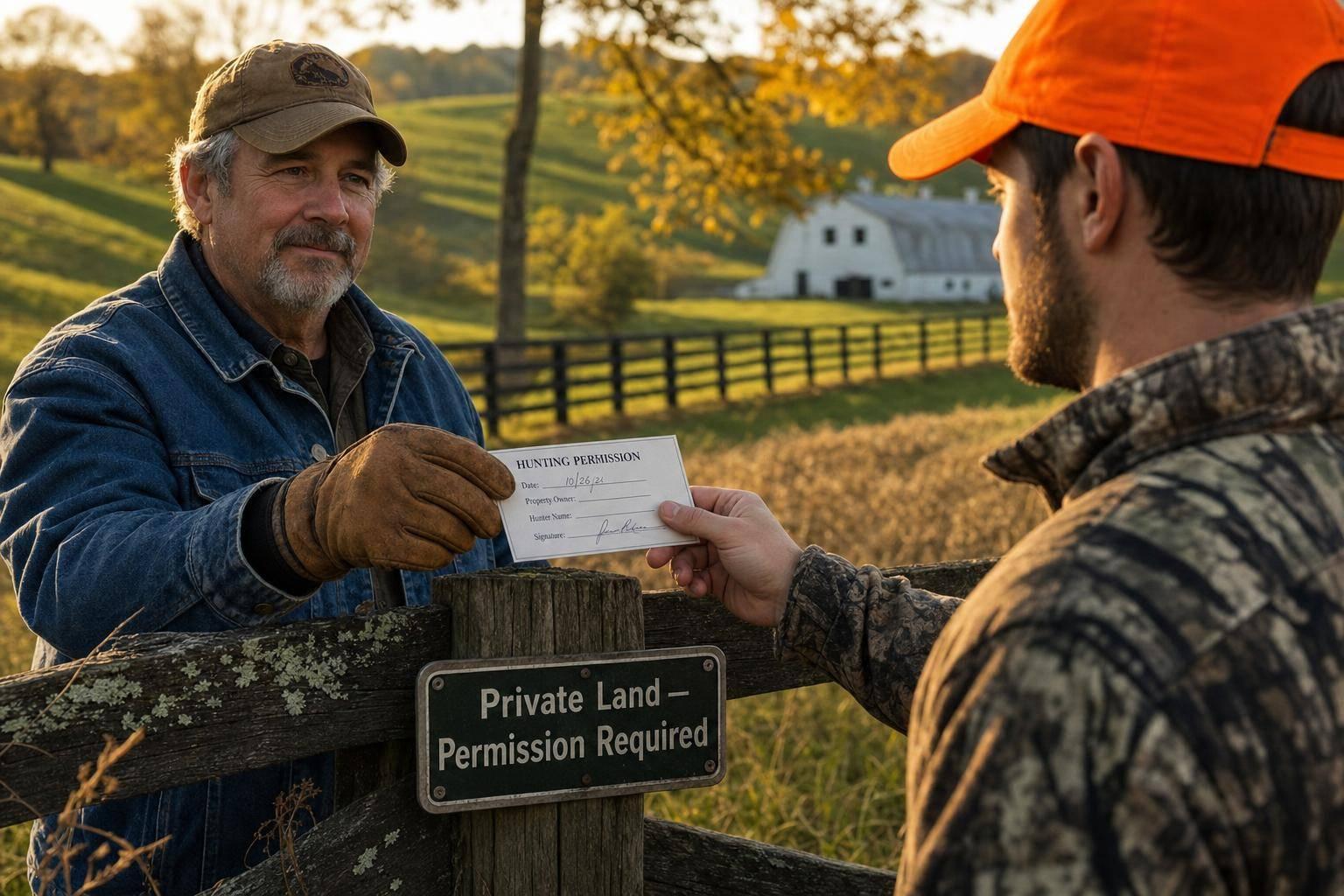
If I hunt private land in Kentucky without permission, I can get cited, fined, lose my license, and in some cases face jail time. Under KRS 150.092, I need permission from the owner, tenant, or someone with authority before I enter private land to hunt, fish, shoot, or trap.
Here’s the short version:
- Oral or written permission can work
- Written proof is safer if I get checked
- Old permission may no longer count
- A friend’s word is not enough
- A valid hunting license does not replace permission
- A wounded deer crossing a property line does not let me enter next door without permission
- First-offense fines start at $100
- Repeat cases can bring license loss for 1 to 3 years
- A third or later offense can mean up to 1 year in county jail
The main point is simple: ask first, keep proof with me, and know the property line before I hunt. That cuts down the risk of trespass charges, license trouble, and disputes with landowners.
Quick facts
| Rule | What I need to know |
|---|---|
| Permission | Must come from the owner, tenant, or an approved agent |
| Form | Oral or written, but written is easier to prove |
| First offense | $100–$300 fine |
| Second offense | $300–$1,000 fine |
| Third or later offense | $1,000 fine and up to 1 year in jail |
| License loss | 1 to 3 years for second and later offenses |
| Wounded game | I still need permission to cross onto private land |
Bottom line: if I do not have clear permission, I should stay out. If you have questions about access or booking a trip, you can contact a hunting guide for professional assistance.
Breaking down Kentucky’s new hunting law
sbb-itb-e01ab49
Kentucky landowner permission laws explained
In Kentucky, you need permission before you enter private land to hunt, fish, shoot, or trap. The key issue is simple: who has the legal right to say yes?
What counts as private land and who can grant permission
Private land includes farms, timber tracts, leased ground, and small parcels. WMAs follow separate public-land rules. Alternatively, you can book a guided hunt on managed private land to ensure all access permissions are handled for you.
Only the owner, tenant, or a person they authorize can grant permission. If someone else says it’s fine, that doesn’t count.
Once you know who can approve access, the next step is being able to prove it if you’re checked in the field.
Oral permission vs. written proof in the field
Kentucky accepts either oral or written permission. But in practice, written proof is the safer move. Oral permission may be legal, but it can be tough to prove on the spot.
The safest options are:
- a signed note
- a dated text
- an email from the person with authority
Written proof is not required by statute, but it’s the cleanest way to avoid disputes.
| Permission Type | Practical Risk |
|---|---|
| Written (signed note, email, text) | Low – easiest to show during a field check |
| Oral only | Higher – harder to verify on the spot |
| Assumed or secondhand | Very high – invalid access |
Common permission mistakes Kentucky deer hunters make
Most hunters aren’t trying to break the law. But once deer season starts, a few bad assumptions can turn into a citation fast.
Assumed access, old permission, and secondhand approval
Old permission doesn’t last forever. If ownership or control of the land changes, that past approval is no good. Access has to come from the current owner, tenant, or authorized agent.
The same thing applies to secondhand approval. If a buddy tells you a neighbor is fine with you hunting the back field, that still isn’t legal permission unless the neighbor clearly gave your buddy authority to pass that permission along. A friend, relative, or fellow hunter can’t speak for a landowner unless they were directly given that right.
The safe move is simple: verify permission every season, and get it straight from the person who currently owns or works the land.
And these problems don’t just happen at the gate. They show up at property lines too.
Road hunting, fence-line errors, and wounded deer crossing property lines
In Kentucky, it’s illegal to shoot from or across a public road or its right-of-way, even if you have valid permission to hunt the private land next to it.
Fence lines cause trouble too. A stand or blind set close to a boundary can lead to a shot that crosses onto the next property. That’s why it helps to check your exact location with GPS mapping tools before the season starts, not after a deer is already on the ground.
Recovery is another spot where hunters get jammed up. Kentucky does not let you enter neighboring land without permission, even when you’re tracking a wounded deer. Following a blood trail may feel like the obvious thing to do, but the law still requires permission before you step across that line.
"Hunters must have permission to enter private property to retrieve wounded livestock or any other reason." – Kentucky Department of Fish & Wildlife Resources
A smart step is to talk with neighboring landowners about recovery access before opening day.
Landowners, tenants, youth hunters, and nonresident owners
Who is doing the hunting matters too, because permission authority and license status are not the same thing.
Kentucky gives a license and permit exemption to resident landowners hunting their own land. That exemption also covers their spouse, dependent children, and a tenant who lives on and works the property. But it stops there.
Nonresident owners still need nonresident licenses and permits. Invited guests and youth hunters can get into trouble if they assume the person who brought them had the right to grant access. Only the owner, tenant, or a formally authorized agent can do that.
Even when a license exemption applies, the rest of the rules still do. Hunters must follow season dates, bag limits, tagging rules, and hunter orange requirements during firearms seasons.
Penalties for hunting without landowner permission in Kentucky
If you don’t have permission, this stops being a mix-up and becomes an enforcement issue.
Fines, repeat offenses, jail exposure, and license consequences
Hunting without landowner permission in Kentucky can lead to fines, jail time, and loss of hunting rights.
A first offense carries a $100 to $300 fine. A second offense carries a $300 to $1,000 fine. A third or later offense carries a $1,000 fine and up to 1 year in county jail.
A second or later offense also requires revocation of hunting, fishing, or trapping privileges for 1 to 3 years. And it can get worse fast. If the land is fenced or posted, you could also face criminal trespass charges. If someone damages a gate, cuts a fence, or destroys crops, that can bring added criminal mischief charges.
How permission interacts with licenses, tags, and other hunting rules
Permission from the landowner does not take the place of a license or deer permit.
Most hunters still need a valid Kentucky hunting license and the right deer permits. Season dates, harvest reporting, equipment rules, and hunter orange rules still apply. If you break any of those rules, a conservation officer can cite you whether the landowner said yes or not.
On the flip side, having a valid license does not excuse hunting without permission.
Comparison table: permission, licensing, and legal risk
You can see the gap pretty fast once you compare the situations side by side.
| Scenario | Legal Status | Likely Penalties | Risk of Citation | Effect on Future Access |
|---|---|---|---|---|
| Permission + required license | Legal | None | Low | Maintains positive landowner relationship |
| Permission + missing license or permit | Illegal | Fines for license/tag violations; potential seizure of game | High (during routine checks) | May damage trust with the landowner |
| No permission + valid license | Illegal | $100–$1,000 fine; potential jail (third or subsequent offense); mandatory license revocation for second and subsequent offenses | High (if reported by owner) | Likely permanent ban from property; possible loss of hunting privileges |
A valid license does not erase a permission violation. Conservation officers and other Kentucky peace officers must enforce KRS 150.092.
How to get permission and protect your hunting access
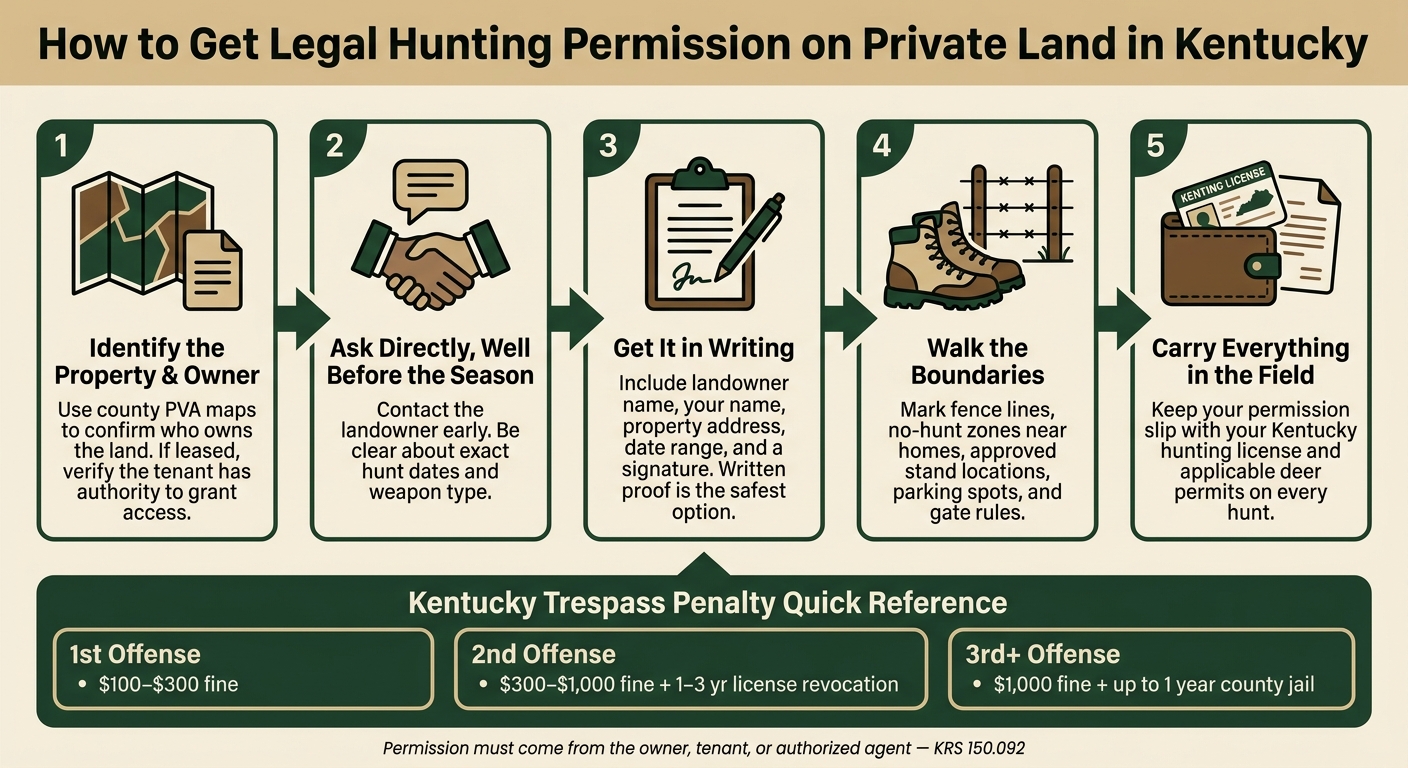
How to Get Legal Hunting Permission on Private Land in Kentucky
Treat the permission rule like a checklist you can use every season. If you handle access the right way from the start, you can avoid trespassing issues, awkward run-ins, and arguments in the field. The goal is simple: turn legal permission into access you can use with confidence.
A 5-step process for legal private-land hunting
Start by confirming ownership. Then lock down proof and boundaries so nothing is left fuzzy.
- Identify the property and owner Use county PVA maps to confirm who owns the land. If the property is leased, check whether the tenant has the authority to grant access.
- Ask directly, well before the season Talk to the landowner early. Be clear about the exact dates you want to hunt and the weapon type you plan to use. That kind of direct communication can save you from trouble later.
- Get it in writing Kentucky allows oral or written permission, but written proof is the safer move. Include the landowner’s name, your name, the property address or parcel description, the date range, and a signature.
- Walk the boundaries If the owner is open to it, walk the property together. Mark fence lines, no-hunt zones near homes or outbuildings, and approved spots for tree stands or blinds. Also confirm where to park and which gates need to stay closed.
- Carry everything in the field Keep your permission slip with your Kentucky hunting license and any deer permit that applies. Bring both on every hunt.
How to treat landowner property before, during, and after the hunt
Small habits go a long way if you want to keep access year after year.
Close every gate you open. Stay off muddy farm roads unless the landowner has said it’s okay. Pack out all trash, including spent shell casings. A quick thank-you text or a short stop-by before you leave also helps show respect for the property and the person letting you use it.
Using guided private-land hunts with clear permission protocols
Whitetail Hunting Kentucky offers guided private-land whitetail hunts in Northeastern Kentucky with pre-established landowner agreements and clearly marked boundaries. Access is cleared before the hunt begins.
Conclusion: Ask, document, and respect boundaries
The safest rule is simple: never assume access. Kentucky law requires permission before you enter private land to hunt, and that permission must come from the owner, tenant, or another authorized person. When you can, carry written proof and keep it with you in case an officer asks about your access.
Know exactly where the property line is before you hunt, and treat posted or marked land as off-limits unless permission is clear. Check boundary markers and fence lines before the season starts. It also helps to talk with neighboring landowners ahead of time about what to do if wounded game crosses onto another property.
It’s smart to confirm access each season so you’re not relying on old permission. Follow any conditions the landowner sets, keep your permission up to date, and leave the property in good shape. Ask first, keep proof with you, and stay within the boundaries you were given.
FAQs
How do I prove permission in the field?
Carry oral or written permission from the landowner, tenant, or other authorized person who allowed you to access the land for hunting or wildlife-related activities.
If permission was given verbally, it’s still smart to carry a written note or signed permit. Keep any exemption permit or hunter education documentation easy to reach as well.
Does last season’s permission still count?
Generally, no. Permission from last season usually doesn’t carry over.
Before you hunt on private land, get current, specific permission from the landowner or another authorized person.
Can I recover a deer on neighboring land?
No. In Kentucky, you need landowner permission to enter neighboring private property to hunt or retrieve game.
Without permission, recovering a deer on that land is not allowed under state law.