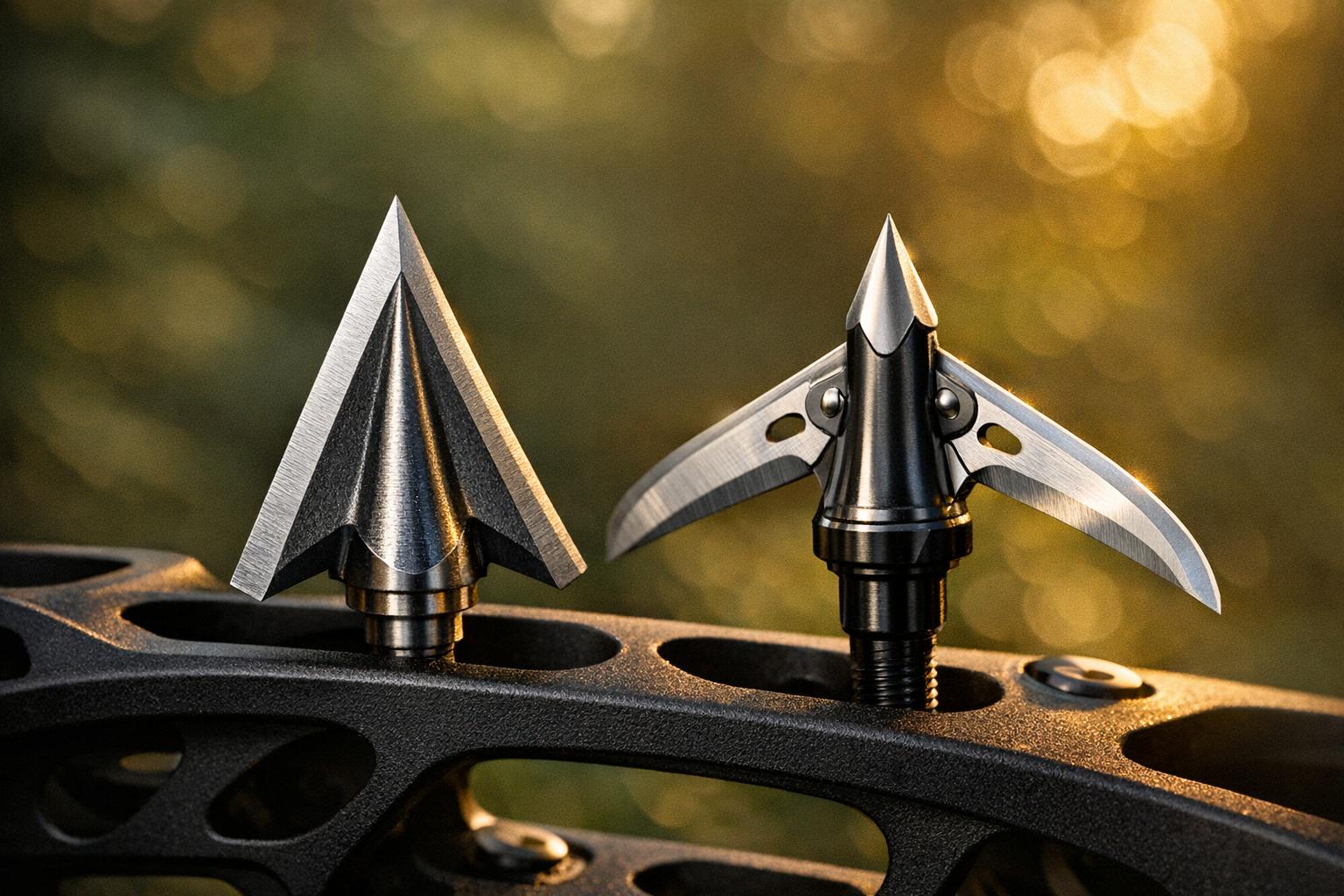
When choosing between fixed-blade and mechanical broadheads for bowhunting, it boils down to your priorities and hunting conditions. Fixed-blades are reliable, durable, and excel at penetrating bone, making them ideal for tough shots like quartering-to angles. Mechanical broadheads, however, offer better flight accuracy and larger wound channels, which are great for clean soft-tissue hits and blood trails.
Key Takeaways:
- Fixed-Blades: Tough, no moving parts, better for bone penetration, but require precise bow tuning for accuracy.
- Mechanical Broadheads: Streamlined flight, wide cutting diameters, but less durable and require more kinetic energy to deploy.
Quick Comparison:
| Feature | Fixed-Blade | Mechanical |
|---|---|---|
| Accuracy | Requires tuning (~1.44" variance at 20 yards) | More forgiving (~0.89" variance) |
| Penetration | Strong against bone | Reduced on bone impact |
| Durability | High | Lower (prone to damage) |
| Cutting Diameter | Moderate | Large (1.5–2"+) |
| Deployment Reliability | No risk (no mechanism) | Can fail or deploy early |
Your bow setup, shot angle, and hunting terrain should guide your decision. This is especially true when preparing for ultimate whitetail hunts in Kentucky where diverse landscapes demand versatile gear. Fixed-blades like the Wasp Mortem ($33/3-pack) are great for tough conditions, while mechanicals like the Swhacker 100-grain excel with high-speed bows and broadside shots.
Fixed-Blade Broadheads: Durability and Reliability
Design and Construction
Fixed-blade broadheads are all about simplicity and strength. Their design often features a one-piece ferrule and tip, ensuring consistent spin and precise accuracy.
The choice of materials plays a huge role in their performance. These broadheads are typically crafted from stainless steel, high-carbon steel, or A2 tool steel. Some manufacturers, like Iron Will Outfitters, go a step further with advanced processes like triple temper heat treatment and cryogenic quenching. This results in steel with a Rockwell hardness of 60 HRc, giving the blades an incredibly tough edge that can withstand heavy impacts. Additionally, most high-quality fixed-blade models use all-steel ferrules, which are far stronger and more resistant to bending or damage.
Flight Behavior and Tuning
When it comes to flight characteristics, fixed-blade broadheads demand a bit more attention. The exposed blades create extra surface area during flight, which can lead to challenges at higher arrow speeds – especially beyond 265 feet per second. This extra surface area can cause the arrow to plane, meaning it might veer off course like a small wing catching air. Because of this, precise bow tuning is essential. Proper paper-tuning before the hunting season ensures that fixed-blade broadheads perform with accuracy comparable to mechanical options when paired with a finely tuned bow.
Penetration and Durability
The real strength of fixed-blade broadheads lies in their penetration and durability. Thanks to their straightforward, non-deploying design, they channel 100% of the arrow’s kinetic energy into penetration.
As Will Brantley, Hunting Editor at Field & Stream, explains:
"That fixed-blades hold up against and penetrate through heavy bone better than mechanicals isn’t even a debate."
Their construction also provides full-length ferrule support, unlike many mechanical designs that rely on a single pivot point. This added support prevents blades from breaking or shearing off when encountering tough obstacles like scapulas or ribs. This durability makes fixed-blade broadheads especially reliable for quartering shots or scenarios where heavy bone penetration is critical. Their rugged build ensures they perform consistently in challenging hunting conditions.
sbb-itb-e01ab49
Mechanical Broadheads: Accuracy and Cutting Power
Deployment Mechanism
Mechanical broadheads are designed to keep their blades folded during flight, opening only upon impact. This feature allows them to achieve a larger cutting diameter – often 1.5 to over 2 inches – resulting in wide wound channels and noticeable blood trails.
There are two primary deployment styles: jack-knife models, which open by rotating from the front, and cam or slide models. According to bowhunter and author Joe Bell:
"My favorite models cam or slide open, which eliminates the chance for kick-out, which can happen with jack-knife style mechanical heads."
While these designs enhance performance in the field, they do come with tradeoffs. For instance, some of the arrow’s kinetic energy is used to deploy the blades, which can reduce penetration compared to fixed-blade heads.
Flight Accuracy
Since the blades stay tucked in during flight, mechanical broadheads minimize exposed surface area, eliminating the planing issues often seen with fixed blades. This streamlined design also enhances fletching performance. In a test of 33 broadhead models, 13 of the 20 that achieved a perfect five-star accuracy rating were mechanicals. On average, mechanical broadheads showed a variance of 0.89 inches at 20 yards, compared to 1.44 inches for fixed-blade heads.
This precision makes mechanicals ideal for modern high-speed compound bows and crossbows firing at 265 fps or higher, where fixed blades can struggle to maintain stable flight. They’re also more forgiving of minor tuning errors or less-than-perfect releases – an advantage for hunters who may not have spent extensive time practicing before the season.
Common Tradeoffs
One major drawback of mechanical broadheads is their performance against bone. In standardized tests using cattle ribs, only 9% of mechanical broadheads remained completely intact, and 75% received durability ratings of three stars or fewer. The blades, often held by a single retaining screw, are more prone to bending or breaking compared to fixed-blade designs, which are supported along their entire length.
Another issue is the potential for premature deployment. High arrow spin can cause the blades to open mid-flight. Hunters often use rubber bands or O-rings to keep the blades secure, but these mechanisms should be checked regularly, especially when moving through brush, as contact with vegetation can accidentally trigger deployment. Will Brantley, Hunting Editor at Field & Stream, highlights this concern:
"I’ve seen more game hit and lost with mechanical broadheads than with fixed-blades."
Despite these challenges, mechanical broadheads excel in specific scenarios. Dave Hurteau, Executive Editor at Field & Stream, explains their advantage on soft-tissue hits:
"If you hit a deer too far back, toward the paunch, penetration isn’t an issue… What you need in this case is to make as big a hole as possible – and you want a really good blood trail."
Fixed VS Mechanical Broadheads – What The Science Says
Side-by-Side Comparison: Field Performance
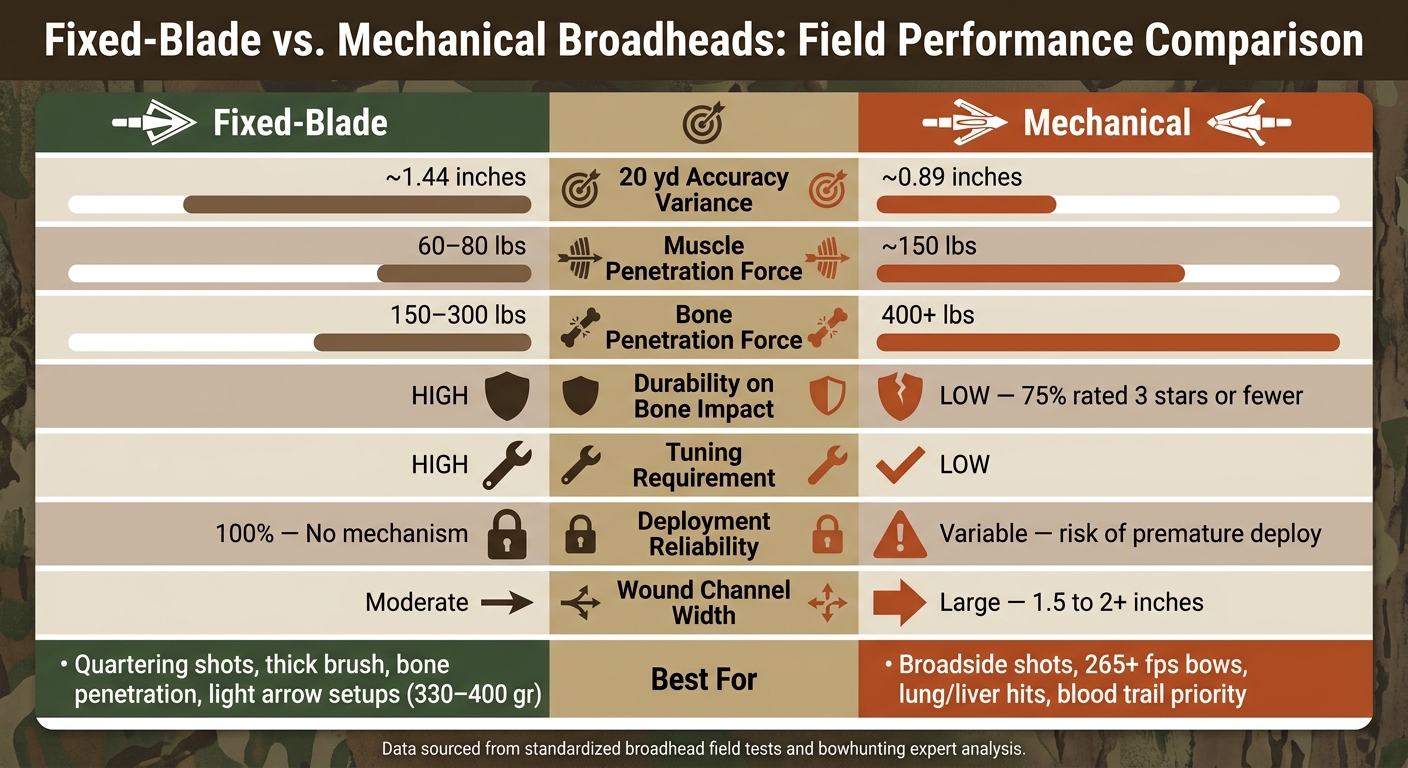
Fixed-Blade vs. Mechanical Broadheads: Field Performance Comparison
Accuracy and Tuning Requirements
Field tests reveal a clear difference in accuracy: mechanical broadheads show a variance of just 0.89 inches at 20 yards, compared to 1.44 inches for fixed-blade heads at the same range. At 60 yards, both average a 4.83-inch variance, but at typical whitetail hunting distances, mechanicals hold an edge.
The key lies in aerodynamics. Joe Bell explains:
"Blade surface area is what hurts fixed-blade heads from flying accurately. From a poorly tuned bow, such heads usually spell disaster, particularly when arrow speeds reach 265 feet per second and beyond."
Mechanical broadheads fly more like field points straight out of the box, reducing the need for extensive paper tuning. This means hunters can spend less time adjusting and more time refining their aim. However, this aerodynamic advantage comes with tradeoffs in penetration.
Penetration and Bone Resistance
When it comes to pushing through hide and muscle, fixed blades require 60–80 lbs of force, making them a more forgiving option for less-than-perfect shots. Mechanicals, on the other hand, need around 150 lbs for the same task due to the energy used to open their blades upon impact. The difference becomes even more pronounced against bone: fixed blades require 150–300 lbs to penetrate, while mechanicals can demand 400+ lbs, placing greater demands on bow setups.
Will Brantley, Hunting Editor at Field & Stream, puts it succinctly:
"That fixed-blades hold up against and penetrate through heavy bone better than mechanicals isn’t even a debate."
Joe Bell adds to this with a technical perspective:
"A moving mechanism made of the same material and of size is always weaker than a non-moving one – really, an indisputable fact of engineering."
While fixed blades excel in penetration, their durability under impact further sets them apart.
Durability and Deployment Reliability
Fixed-blade broadheads shine in durability. With no moving parts, they maintain their integrity from launch to impact – there’s no risk of energy loss or mechanical failure. Mechanical heads, however, rely on a deployment mechanism that must function flawlessly every time.
Data from standardized bone-impact tests highlights this difference: only 9% of mechanical broadheads remained completely intact after hitting cattle ribs, and 75% received durability ratings of three stars or fewer. Fixed blades, with blades supported along their entire length, consistently perform better under these conditions.
The table below summarizes how these performance metrics translate to real-world reliability for whitetail hunting:
| Category | Fixed-Blade | Mechanical |
|---|---|---|
| 20 yd Accuracy Variance | ~1.44" | ~0.89" |
| Muscle Penetration Force | 60–80 lbs | ~150 lbs |
| Bone Penetration Force | 150–300 lbs | 400+ lbs |
| Durability on Bone Impact | High | Low (75% rated ≤3 stars) |
| Tuning Requirement | High | Low |
| Deployment Reliability | 100% (no mechanism) | Variable |
| Wound Channel Width | Moderate | Large (1.5–2"+) |
The choice comes down to priorities: mechanicals offer better flight accuracy and wider wound channels for soft-tissue hits, while fixed blades provide superior penetration and durability when the shot isn’t perfect.
Choosing the Right Broadhead for Your Whitetail Hunt
Selecting the right broadhead requires aligning its features with your hunting environment and equipment setup.
Matching Broadheads to Hunting Conditions
Your choice of broadhead should depend on factors like shot angle and bow setup. Fixed-blade broadheads are particularly effective for quartering-to shots, as they can break through leg bones to reach vital organs. Mechanical broadheads, however, may struggle in such scenarios. Will Brantley, Hunting Editor and licensed Kentucky outfitter, highlights this advantage:
"The fixed-blade’s biggest advantage is for quartering-to shots… if a fixed-blade hits the leg bone at that angle, it usually breaks it and penetrates more than enough to quickly kill anyway."
For broadside or quartering-away shots into the rib cage, mechanical broadheads shine. Their wider cutting diameters – often 2 inches or more – can create heavier blood trails, making tracking easier, especially with high-speed setups exceeding 265 fps. However, in thick brush, mechanical broadheads can accidentally deploy if they brush against vegetation.
These nuances are especially important when navigating Kentucky’s diverse hunting environments.
Broadhead Selection for Kentucky Whitetail Hunting
Northeastern Kentucky’s varied terrain demands careful consideration of shot angles and equipment. Elevated stands, for example, often favor fixed-blade broadheads for steep-angle shots. Charles Hart, owner of Hart Farms Processing in Almo, Kentucky, shares his observations:
"Most of the deer that come in have been killed with a rifle – and I cannot tell you how many mechanical broadheads we’ve pulled out of them… We find anywhere from 10 to a dozen mechanicals every year, but only occasionally will we find a fixed head."
This insight highlights the importance of tailoring your broadhead choice to Kentucky’s unique hunting conditions. If you’re booking with Whitetail Hunting Kentucky, make sure to discuss your bow setup – including draw weight, arrow weight, and typical shot angles – with your guide for the best results.
Final Recommendations
When considering performance and environmental factors, arrow weight plays a critical role. Light arrow setups (330–400 grains) can significantly limit penetration when using large-diameter mechanical broadheads. In such cases, fixed-blade broadheads or mechanicals with smaller cutting diameters (around 1.5 to 1.75 inches) are better options.
Here’s a quick guide to help you choose the right broadhead for your hunting needs:
| If You… | Go With… |
|---|---|
| Shoot a well-tuned bow at 265+ fps | Mechanical (1.5–1.75" cut) |
| Anticipate quartering-to shots | Fixed-blade |
| Hunt thick brush in Northeastern Kentucky | Fixed-blade |
| Prioritize a robust blood trail on lung/liver hits | Mechanical |
| Use a light arrow setup (330–400 gr) | Fixed-blade or small-diameter mechanical |
For versatility in Kentucky’s terrain, a high-quality fixed-blade broadhead like the Wasp Mortem (~$33 for a 3-pack) or the Iron Will SX125 (~$33 per head, with a lifetime warranty) is a dependable choice. If your setup is well-tuned and you’re confident in your shot placement, a mechanical broadhead such as the Swhacker 100-grain with its 2-inch cutting diameter can deliver excellent results on clean lung shots.
FAQs
How do I know if my bow has enough energy for mechanical broadheads?
To figure out if your bow can provide enough energy for mechanical broadheads, you’ll need to look at its kinetic energy output. Mechanical broadheads require enough energy to open fully upon impact. If the energy is too low, their performance can suffer. Make sure your bow meets the required energy levels to ensure they work as intended when you’re out in the field.
What arrow weight works best for fixed-blade vs. mechanical broadheads?
Fixed-blade broadheads tend to deliver better results when paired with slightly heavier arrows, typically in the range of 350–550 grains. This added weight helps improve both durability and penetration. On the other hand, mechanical broadheads, which depend on speed and balance for effective blade expansion, usually perform best with arrows weighing between 400–500 grains.
Choosing the right arrow weight ultimately comes down to your specific setup and hunting approach. However, aiming for the 400–500 grain range often strikes a good balance for reliable performance with either type of broadhead.
Which broadhead type is better for steep or quartering shot angles?
Fixed-blade broadheads tend to perform better on steep or quartering shot angles. Their design ensures consistent penetration and accuracy, even in tough scenarios, as they don’t depend on mechanical parts that could fail or deploy improperly. On the other hand, mechanical broadheads, which open upon impact, can be less reliable in these situations. Their moving parts increase the risk of deflection or incorrect deployment, making them a bit more unpredictable.