If I want the best odds during Kentucky’s peak rut, I keep it simple: hunt November 8–15, call less, place the decoy for the shot, and let the wind do part of the work. The hottest stretch is November 10–12, and the article’s main point is clear: during that window, bucks move more in daylight, react better to grunts and bleats, and can be guided into 30- to 40-yard shots with the right setup.
Here’s the short version I’d use in the woods:
- Best timing: Peak rut runs Nov. 8–15, with the steadiest breeding activity on Nov. 10–12
- Best calling range: Soft grunts and bleats work best for pulling a buck the last 30–40 yards
- Best midday window: 11:00 a.m. to 1:00 p.m. can be just as good as dawn or dusk
- Best decoy distance: Set a decoy 10–30 yards from my stand or blind
- Best wind setup: Put the decoy upwind so a circling buck moves through my lane
- Best mindset: Read the buck first; don’t call just because I can
- High-risk calls: Rattling and snort-wheezes fit only when the buck, cover, and pressure level line up
- Best terrain fits: Funnels, saddles, ridge trails, creek bottoms, food plot edges, and inside corners
What stood out to me is that the article is less about making noise and more about control. I’m using calls to get attention, a decoy to shape where the buck stops, and the wind to steer his path. That’s the whole play.
Rut Calling Tips That Actually Work | Grunts, Bleats & Real-World Scenarios
sbb-itb-e01ab49
Quick Comparison
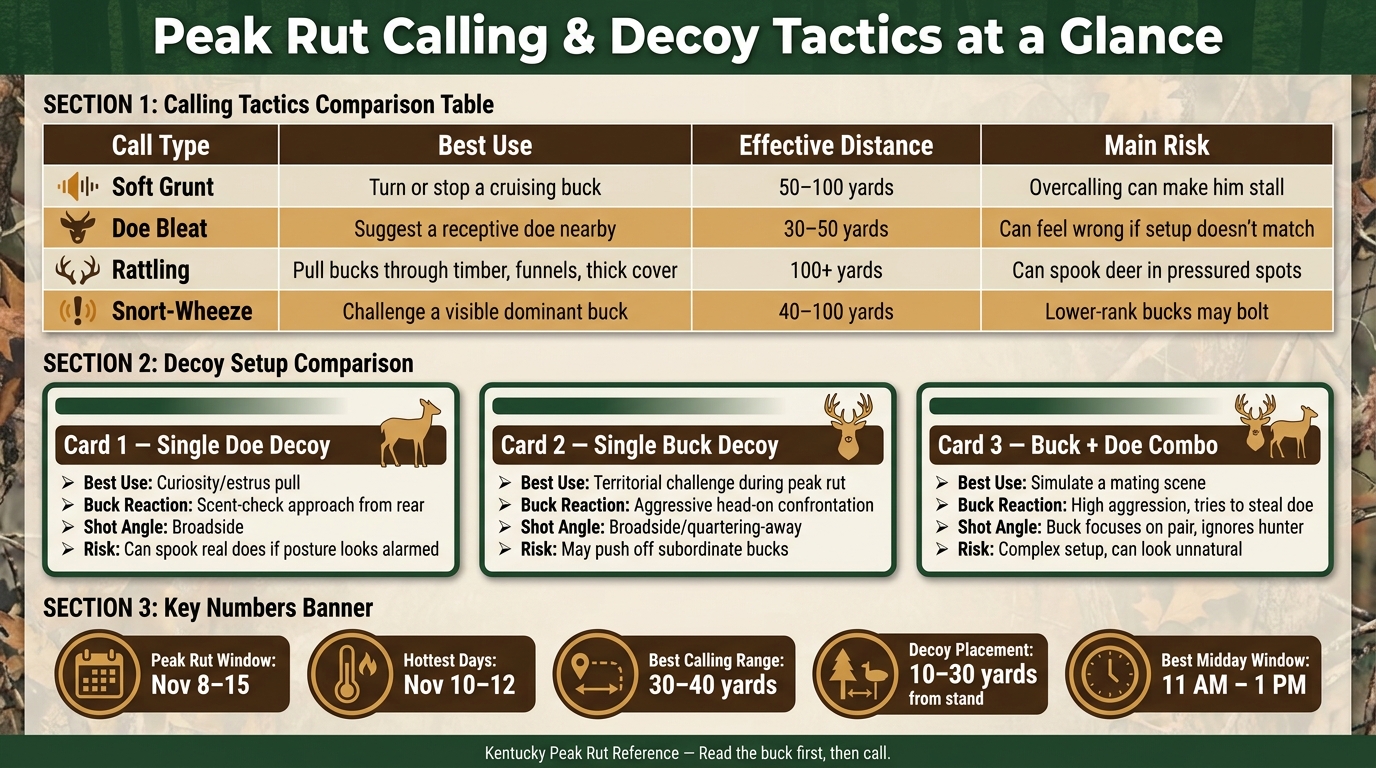
Deer Calling & Decoy Tactics: Quick Reference Guide for Peak Rut
| Tactic | Best Use | Distance | Main Risk |
|---|---|---|---|
| Soft grunt | Turn or stop a cruising buck | 50–100 yards | Overcalling can make him stall |
| Doe bleat | Suggest a doe close by | 30–50 yards | Can feel wrong if the setup doesn’t match |
| Rattling | Pull bucks through timber, funnels, and thick cover | 100+ yards | Too much in pressured spots can spook deer |
| Snort-wheeze | Challenge a mature buck you can see | 40–100 yards | Lower-rank bucks may bolt |
| Doe decoy | Curiosity and scent-check behavior | 10–30 yards from stand | Wrong posture can alert deer |
| Buck decoy | Trigger a face-to-face challenge | 10–30 yards from stand | Can push off younger bucks |
| Buck + doe decoys | Copy a breeding scene | 10–30 yards from stand | Harder to set up in a natural way |
I’d sum it up like this: during peak rut, the best setups are the ones that look, sound, and smell right without overdoing any one part. The article backs that up with timing, shot distance, terrain fit, and buck behavior from start to finish.
Peak Rut Calling Basics for Close-Range Shots
Read Buck Behavior Before You Call
The 11 AM to 1 PM stretch can be just as good as first light or last light. What matters here isn’t making noise for the sake of it. It’s getting a buck close enough for a bow or crossbow shot.
If you spot a calm buck cruising within earshot but still outside range, a soft grunt can help turn the situation in your favor. But if that buck has already locked onto your stand, don’t call. In that spot, the sound often makes him stop short.
Use Grunts and Bleats to Pull Bucks Into the Last 30 to 40 Yards
For those final yards, short contact grunts and tending grunts are usually your best bet. A tending grunt – a deep, guttural "urrp" repeated every few seconds – tells other deer that a buck has found a doe. That sound can be enough to pull a cruising buck off his path and point him toward your stand.
Keep the sequence brief, then shut it down. After calling, stay dead still for at least 20 minutes. Bucks often slip in slow and quiet. A little movement during that stretch can ruin the whole setup. If a buck stalls at about 80 yards, one soft grunt may be all you need. A full sequence at that point can make him uneasy.
"A buck that heard your grunt and is coming cautiously will often stop, stare hard in your direction… Don’t grunt again while he’s looking directly at you – wait until he looks away, then call." – Prohunt Editorial Staff
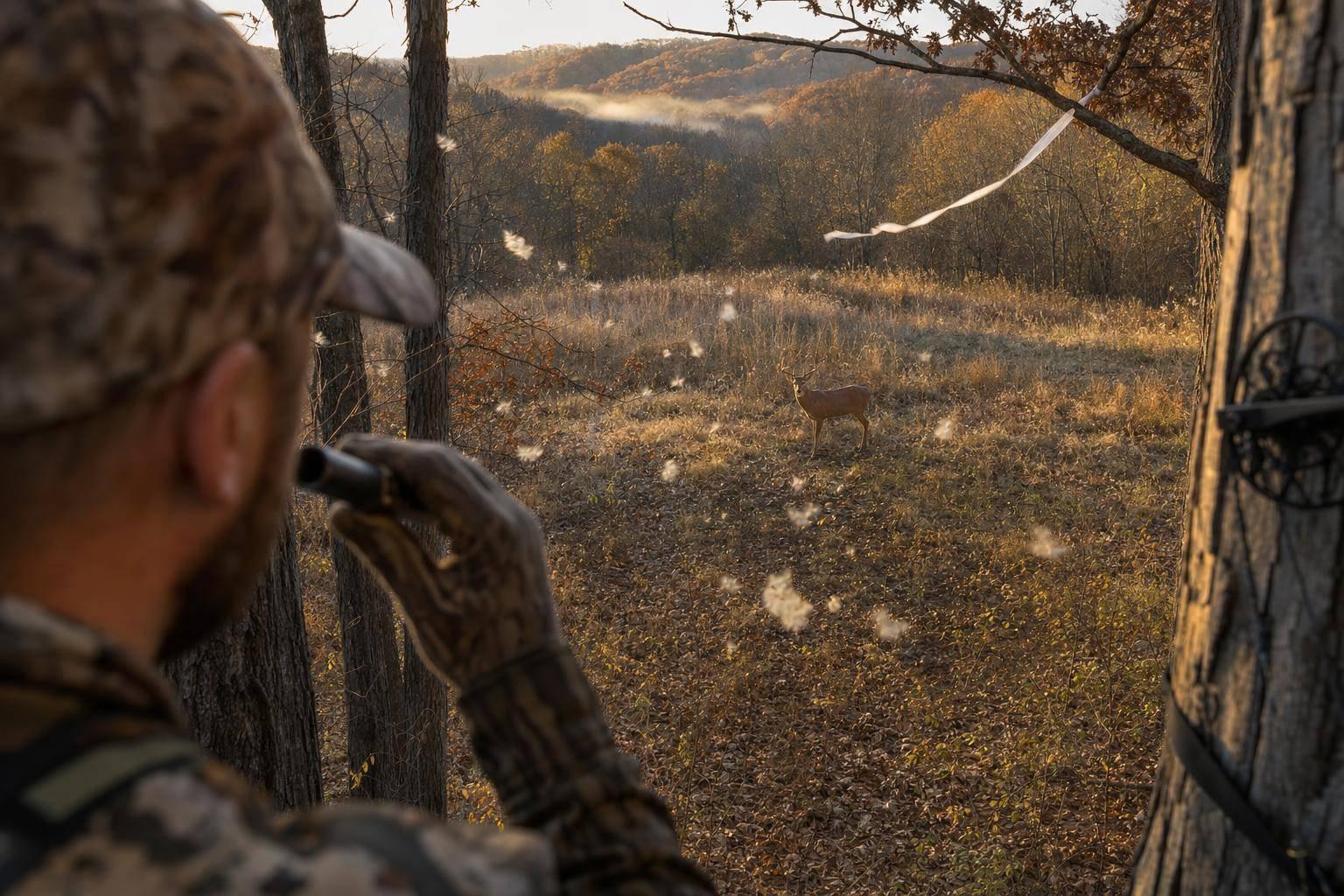
A smart move during ultimate whitetail hunts in Kentucky timber is to point the grunt tube away from the deer and cup your hand over the bell. That softens and shapes the sound so it feels more like a deer moving through the woods, not a hunter sitting still in a tree.
If soft calling stops working, only add pressure if the buck’s mood calls for it.
When to Use Rattling or Snort-Wheeze Calls
Aggressive calling can work during the peak rut, but only when the setup fits. Rattling is best in funnels, on ridges, and near thick cover where a buck can come in without stepping across open ground. Start with a loud clash, then grind the antlers for about 60 seconds before going silent. Actual buck fights can carry hundreds of yards through timber, so volume matters here.
The snort-wheeze sits at the far end of the scale. It’s a sharp, rhythmic burst of air that dares another buck to respond. As Mark Kenyon of MeatEater says:
"The snort-wheeze is like flipping off a guy at the bar. You’re looking for a fight." – Mark Kenyon, MeatEater
Use that call only when you can see a mature, dominant buck. It’s a high-risk play, and younger or lower-rank bucks may spook from it.
| Call Type | Primary Use | Effective Distance |
|---|---|---|
| Grunt Tube | Contact or tending sounds in timber, funnels, and travel corridors | 50–100 yards |
| Doe Bleat | Suggest a receptive doe near field edges or doe bedding | 30–50 yards |
| Snort-Wheeze | Direct challenge to a visible dominant buck | 40–100 yards |
| Rattling | Simulate a fight over a doe in funnels, ridges, and thick cover | 100+ yards |
Once a buck commits to the call, decoy placement can help bring him the rest of the way. To experience these tactics firsthand, you can book a hunt on managed private land.
Decoy Setups That Improve Shot Angles
Once a buck answers the call, the decoy should finish the job by steering him into a broadside or quartering-away shot. Put simply: calling brings the buck in, but decoy placement decides where he stops.
Choose the Right Decoy for the Buck Reaction You Want
Pick the decoy based on the reaction you’re trying to get.
A doe decoy works well when you want low-pressure curiosity and scent-check behavior. A smaller, posturing buck decoy can trigger a challenge without scaring off younger bucks. If your goal is a better shot angle, point the buck decoy toward your stand. Most approaching bucks will want to face that rival head-on, which often turns their side or rear toward you.
"I like to face a buck decoy toward me. The buck will want to fight the decoy, so he’ll position himself facing away from me. This sets me up for a good broadside shot." – Brad Bever, Designer, Montana Knife Company
| Decoy Setup | Best Use | Likely Buck Reaction | Shot-Angle Benefit | Where It Can Fail |
|---|---|---|---|---|
| Single Doe | Curiosity/estrus pull for cruising bucks | Approaches from the rear to scent-check or breed | Broadside as he scent-checks the rear | Can spook real does if the posture looks alarmed |
| Single Buck | Territorial challenge during peak rut | Aggressive, head-on confrontation | Broadside/quartering away as he faces the decoy | May intimidate and push off subordinate bucks |
| Buck & Doe Combo | Simulating a mating scene | High aggression; buck tries to steal the doe | Buck focuses on the pair and ignores the hunter | Complex to set up; can look unnatural if spaced poorly |
Place the Decoy Upwind and Slightly Off the Expected Trail
Next comes the part that makes the setup work. Place the decoy 10 to 30 yards from your stand or blind, and keep it upwind of your position. That setup can force a circling buck to move between the decoy and your stand, right through your shooting lane.
Don’t put the decoy right on the main trail. Set it slightly off to the side. That small shift is often enough to make the buck stop in a broadside or quartering-away position instead of facing you straight on.
For scent control, wear gloves when handling the decoy and spray it with scent-eliminating product. Use buck scent lightly on a buck decoy or a nearby wick, and estrus scent on a doe decoy or wick.
Match Decoy Visibility to Your Specific Terrain
Decoy range should match how far a buck can see in that cover. If he can’t spot it in time, the whole setup can fall apart. If he sees it too late, he may lock up in the wrong spot.
In small food plots, a single doe decoy placed about 20 yards from the woodline lets a buck spot it from the timber before stepping into the open. That can stop him at the edge, which is often exactly where you want him.
In creek bottoms and tight funnels, a buck-and-doe combo can work well, especially where sound carries. It can pull the buck into the funnel’s narrowest point and set up a close shot.
On hardwood ridges, place the decoy on the downwind side of a ridge-top trail so a cruising buck sees it at about 50 to 60 yards and angles in broadside. In brushy edges, use nearby cover to break up the decoy’s outline while keeping it visible from the travel corridors bucks already use.
On public ground, always carry your decoy in a blaze orange bag.
Combining Calls, Decoys, and Wind to Control the Encounter
Once the decoy is out, sound and wind finish the setup. Peak-rut success during Kentucky whitetail hunting comes from lining up your call, decoy, and wind so a buck ends up inside shooting range. You’re working with sound, sight, and scent at the same time, from start to finish.
Pair Soft Calling with Decoy Body Language
Match soft bleats with a doe decoy and tending grunts with a buck decoy. Then, once the buck commits, stop calling. If he hangs up, give him one soft follow-up note and then go quiet.
After a buck locks onto the decoy, your next move is simple: make his circle bring him into range.
Use Wind and Entry Routes to Shape the Buck’s Approach
Plan for the downwind circle and make that path cross your lane. Put the decoy upwind of your stand so the buck’s circle carries him past your shooting lane. Use natural barriers behind your stand, like a creek bank, a steep ridge drop, or thick brush, to block bad downwind angles you can’t shoot. If the wind isn’t right, wait for a better setup instead of burning the spot.
The last lever to pull is volume. Pressure changes how bold you can get.
Adjust Calling Aggression Based on Pressure and Deer Behavior
Match your volume and calling pace to the amount of pressure: more aggressive on low-pressure ground, softer and less often on pressured ground. On low-pressure private land during peak rut, loud rattling, a snort-wheeze, and a posturing buck decoy can pull in a dominant buck fast. On pressured public land, stretch your calling intervals to 45 to 60 minutes and keep the volume down. Soft contact grunts and light bleats are often enough, and sometimes the smarter move is to pull the decoy or switch to one relaxed doe decoy.
If a buck flags his tail or snaps his head up, stop calling and reset.
Applying These Tactics on Guided Hunts in Northeastern Kentucky
Use Local Rut Timing and Habitat to Pick the Right Setup
On guided hunts, timing only pays off when it matches the terrain.
In Northeastern Kentucky, the peak-rut window is the best time to hunt funnels where doe activity is strongest. Saddles and inside corners work like natural choke points, giving cruising bucks a place to check for does. As bucks move between bedding and feeding areas, they often slip through these tight spots. And if trail camera data shows heavy doe movement in a certain drainage or along a field edge, that’s a strong sign of where to set up.
"Any time I hunt open or broken cover, I look for a large lone tree or brushpile. Bucks crossing between patches of cover will go to that lone tree like a magnet, pausing to assess their surroundings before moving on." – Mark Clifford, Kentucky Outfitter
That kind of detail matters on guided hunts because small terrain features can shape deer movement in a big way.
Let Guides Help With Stand Choice, Calling, and Decoy Placement
This is where a local guide can make a big difference.
Guides watch how deer move under hunting pressure and use that read to choose the stand and dial in the right amount of calling. They also use trail camera history to spot dominant bucks and other aggressive deer that may respond well. From there, they can place decoys on field edges or in open meadows to draw a buck into a broadside shot. Some may also run a double drag rag to suggest a buck trailing a hot doe.
Inside 40 yards, that kind of planning can be the difference between a buck hanging up and a buck committing.
Conclusion: Keep Calls Realistic, Decoys Believable, and Shots High Percentage
Once the setup is in place, the goal is simple: keep the buck’s approach clean and easy to read.
Don’t overdo it. Keep calls realistic, make sure the decoy looks believable, and play the wind right. Then let the buck finish his circle. That’s often what turns a rut encounter into a high-percentage shot.
FAQs
How do I know when a buck is safe to call to?
Pay close attention to the buck’s body language and the wind. Don’t call when he’s already inside archery range. One extra sound or a small bit of movement can blow the whole thing. When he’s that close, let your decoy and scent setup do the work.
Calling works best when the buck is still out at a distance and you’re in position to handle his likely downwind circle. If a mature buck reacts, stop calling right away and stay still so he can close the gap on his own.
What should I do if a buck hangs up out of range?
If a buck hangs up out of range, fight the urge to call too much. A lot of noise can make an older buck wary, and many will circle downwind to check the scent behind the sound.
If he stalls, stick with soft social grunts. If you’re using a decoy, set it 10 to 30 yards out so his attention stays there instead of on you. Be patient, move as little as possible, and let him come in on his own.
Which decoy setup works best in thicker Kentucky cover?
In thick Kentucky cover, decoys usually don’t work as well as they do in open fields. The reason is simple: bucks need to spot them clearly from a distance.
If you decide to use one, go with a realistic doe decoy and set it in a small opening, like a travel funnel or pinch point, instead of burying it deep in heavy brush. Stay concealed nearby and place the decoy 10 to 30 yards away so you have a clear shot. Also, expect a buck to circle downwind before coming in.